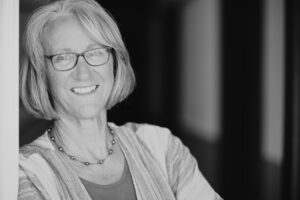
Chrysti “the Wordsmith” Smith – Poplar and Billings, MT
Before she became Chrysti the Wordsmith, our beloved guide into the hidden lives of words, Chrysti Smith was a horse-crazy girl growing up on the Hi-Line.
Born in Culbertson after her mom went into labor in nearby Brockton, her family moved to Poplar when she was 3. Her dad farmed and ran heavy equipment, and her mom taught school. “I come from a small dynasty of teachers,” she says. Education was the through-line, even if school itself was not always easy for her. Poplar didn’t have kindergarten at the time, so she started first grade at age 5, which left her struggling through the early years. “I was just an average or below-average student.”
A Childhood of Freedom
But outside of school, her life was idyllic. She loved horses, and she and her friends would ride everywhere, swimming with them and diving off their backs in the river. Back then, horses could be bought for $25, and those who didn’t have a pasture would let their horses roam free in the wintertime.
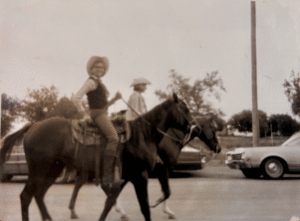 Chrysti, age 13, in a Poplar parade. 1969.
“It was a life of absolute freedom. We could do almost anything we wanted to.”
Poplar in the ’60s and ’70s felt lawless – no traffic, no enforcement, kids roaming until the 10 p.m. curfew siren set every dog in town howling and every kid home. Most kids in her rural community were driving by the time they were 11, tearing around town on a motorcycle or a farm car. “It was a life of absolute freedom. We could do almost anything we wanted to.”
She also learned early what she admired in people: curiosity, intellect, and enthusiasm. Her ninth-grade English teacher, Ms. Hopkins, taught her to diagram sentences while opening her world to anthropology and a different way of thinking. “She was so engaged,” Chrysti remembers. “I ate it up.”
Moving to Billings
At 14, her parents divorced and she moved with her mom to Billings, right next door to Billings Senior. Knowing how much she struggled in school, her mom asked her if she wanted to take 9th grade over in a new setting, with kids her own age. She said she regrets not doing it, because her 9th grade classes would have made more sense to her and high school academics would have been easier. But the thought of spending one more year in school was a deal-breaker.
Even so, she made friends quickly at and was impressed with the teaching staff. “So many of the teachers were serious about their profession. They were the adults in the room.” She loved German and remembers the thrill of taking those classes from two native-speaking teachers. She still can’t believe she didn’t take Latin, which she considered a dead language at the time. But now? “I almost bitterly regret it.”
Old English in Virginia City
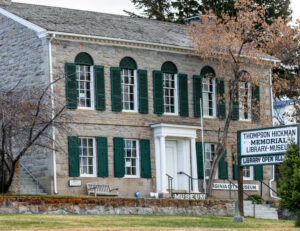
After graduation, she spent a summer in Virginia City with her older sister, an actor with the Virginia City Players. Chrysti’s job was making change for those who wanted to use the coin-operated music machines. When she wasn’t working, she went to the tiny library, where she found thick Victorian tomes, travelogues written by wealthy British men about their discoveries in faraway places. Unfamiliar with many of the Old English words, she bought a blue paperback Webster’s dictionary at a gas station in Ennis and started researching them.
“When I found a word I didn’t understand, I’d look it up, write down the definition, and then test myself.” She said that this was a form of discipline she’d never had before. “I look back in amazement at the young person who did that.”
“When I found a word I didn’t understand, I’d look it up, write down the definition, and then test myself.”
The Angels Start Singing
That fall, she attended UM, but college wasn’t a good fit at that point in her life. She dropped out, got married, and moved to the South. Her husband at the time worked in a B. Dalton bookstore, which supported her love of reading and her growing vocabulary.
A decade later, at age 30, she moved back to Montana and enrolled at MSU to study anthropology. The anthropology program had a linguistics requirement that would prove life altering. “It was like angels came and sang to me,” she says. “A switch turned on. I thought: everyone needs to know this. If I had been a preacher, I could have converted everybody.”
Chrysti Becomes the Wordsmith
In 1990, with no radio experience at all, she walked into KGLT in Bozeman and pitched a radio series about words, linguistics and etymology. To his credit, the station manager said yes. She wrote her first scripts by hand, terrified and exhilarated, learning to read sentences aloud, to use her voice, to write clearly and musically for the ear. A young producer taught her pacing, tone, and craft. She spent most days in the MSU Library, combing through the 20-volume Oxford English Dictionary, researching for what would become hundreds, then thousands, of scripts.

35 years later, Chrysti the Wordsmith airs nationally and is one of Montana’s longest-running creative works: 127 words at a time, meticulously researched and written with the same joy and zest she felt the first time. Digital tools have changed the workflow as well as our access to language, but her devotion to her craft has only increased. “It’s this wild west of linguistic creativity. It just tickles me, delights me. I love it.” Each episode takes four to ten hours to research. Each new word still sends a small shock through her body. The angels still sing.
And Chrysti is still a public school kid whose curiosity, hard work, and quiet confidence carried her forward. She built a life word by word, giving the rest of us the joy of understanding the language that shapes our own.