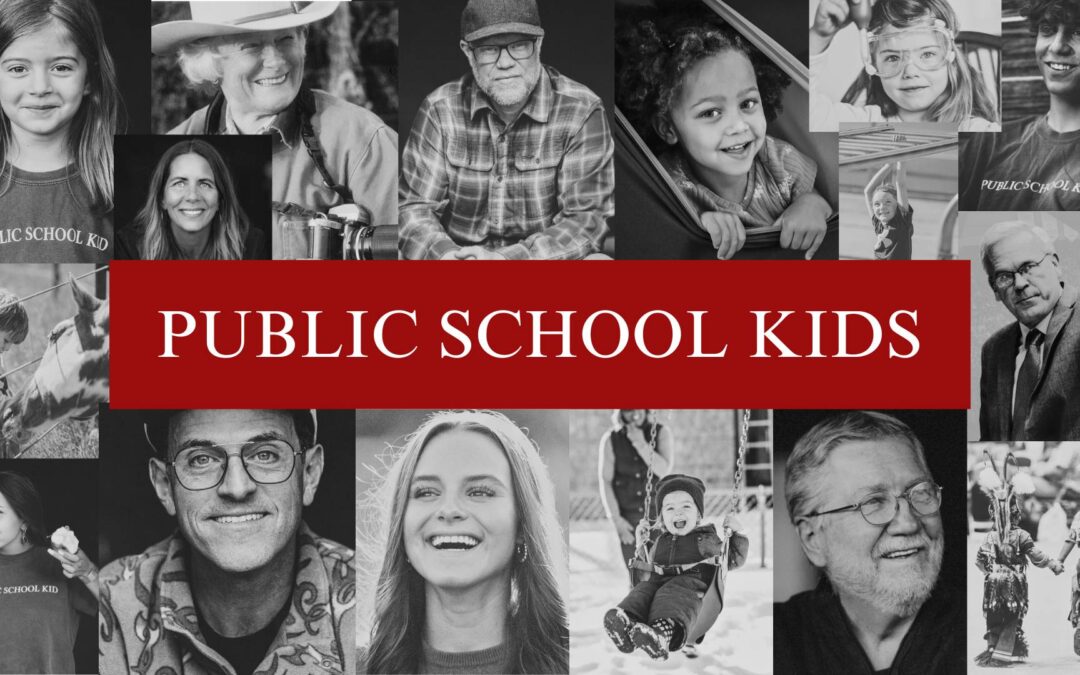
Public School Kids

  • The Yearbook
  • The Podcast
  • Merch
  • Contact
  • Donate
  • Blog
Ryan “Ol’ Cal” Callaghan

Ryan “Ol’ Cal” Callaghan

by admin | Dec 11, 2025 | Coaches, Education, football, Freedom, Montana, Profiles, Public Lands, Public School Kids, Public Schools, Sports, Uncategorized

Ryan “Ol’ Cal” Callaghan Missoula, MT   Ryan “Ol’ Cal” Callaghan grew up in Missoula at a time when the Rattlesnake still felt like a neighborhood wilderness and a place where everyone could afford to live. Born in Billings to a mom from...
Ryan “Ol’ Cal” Callaghan

Chrysti “the Wordsmith” Smith

by admin | Dec 4, 2025 | Education, Freedom, Hi-Line, Montana, Profiles, Public School Kids, Public Schools, Uncategorized, words

Chrysti “the Wordsmith” Smith – Poplar and Billings, MT Before she became Chrysti the Wordsmith, our beloved guide into the hidden lives of words, Chrysti Smith was a horse-crazy girl growing up on the Hi-Line. Born in Culbertson after her mom went into labor in...
Ryan “Ol’ Cal” Callaghan

Robin Selvig

by admin | Nov 24, 2025 | Basketball, Coaches, Education, Freedom, Hi-Line, Montana, Profiles, Public School Kids, Public Schools, Sports, Uncategorized

Robin Selvig – Outlook, Montana Robin Selvig grew up in a town most Montanans have never heard of and even fewer have ever seen. Outlook, a tiny farming community on the Hi-Line in the northwestern-most corner of the state, had about 150 people when Selvig was a...
Ryan “Ol’ Cal” Callaghan

Tammi Fisher

by admin | Oct 2, 2025 | Education, Freedom, Great Falls, Kids, Montana, Profiles, Public School Kids, Public Schools, Uncategorized

Tammi Fisher Attorney. Former Mayor of Kalispell. Podcast host. Community advocate. Great Falls High, Class of 1994 Tammi Fisher’s story is one of Montana grit and a fierce belief in opportunity, responsibility, and the power of public schools to prepare kids for...
Ryan “Ol’ Cal” Callaghan

Monica Gilles-BringsYellow

by admin | Aug 25, 2025 | Artists, Education, Freedom, Montana, Profiles, Public School Kids, Public Schools, Uncategorized

Monica Gilles-BringsYellow Great Falls High Class of 2000 Monica didn’t grow up in a typical Great Falls family. Her mom was from Mazatlán, Mexico and didn’t speak English and her dad – a farmer turned journalist – did the ag report for the Great Falls...
Ryan “Ol’ Cal” Callaghan

Land Tawney – Sentinel High School

by admin | Jul 7, 2025 | Education, Freedom, Montana, Profiles, Public Lands, Public School Kids, Public Schools

Land Tawney Conservationist Sentinel High School, 1993 Most people know Land Tawney as one of the fiercest advocates for public lands and backcountry conservation. But I first knew him as my 3rd grade pen pal. Our teachers paired students from Lewis & Clark and...
« Older Entries

Recent Posts

  • Ryan “Ol’ Cal” Callaghan
  • Chrysti “the Wordsmith” Smith
  • Robin Selvig
  • Tammi Fisher
  • Freedom Week: Popular Sovereignty

Recent Comments

    Recent Posts

    • Ryan “Ol’ Cal” Callaghan
    • Chrysti “the Wordsmith” Smith
    • Robin Selvig
    • Tammi Fisher
    • Freedom Week: Popular Sovereignty

    Recent Comments

    No comments to show.

    public.school.kids

    A storytelling series about the freedom and opportunity public schools create for Montana kids.

    Ryan grew up in Missoula at a time when the Rattle Ryan grew up in Missoula at a time when the Rattlesnake still felt like a neighborhood wilderness, and a place where everyone could afford to live. “I’d fish Rattlesnake Creek all the time,” he says. “And run around on the deer trails for miles.”

Like most kids in that part of town, he started school at Mt. Jumbo, then Prescott, Rattlesnake for junior high, and Hellgate for high school. “It was not a homogeneous upbringing,” he says. “That mix of perspectives and economic classes absolutely prepares you for real life.”

His teachers made lasting impressions: Mr. Rud, the proud Norwegian social studies teacher; Mrs. Marvin, his 3rd grade teacher who had lost three fingers “tying up a mule.” Hellgate choir with Dean Peterson became another major community where all kinds of kids came together. “Dean was amazing, but he would make choir super hard work.”

But it was football that shaped him the most. “It was wildly valuable to me.” Starting in 5th grade with Little Grizzly Football, the program intentionally mixed students from all over town, helping kids broaden their circles and later “diffuse certain social situations” in high school. Big teams, long bus rides, and good coaches helped create a diverse high school community.

“For me,” he says about school, “the thing that I took the furthest was the social skills.”

In college, Ryan worked construction during the day, party rental setups on weekends, and bartended at Red’s at night. “Just a killer education,” he says. “Smart people, crazy drunk people, unhoused people trying to hit you with a bottle, whacked-out frat kids, brides going nuts on the weekends, then building houses and doing other trade work during the week.”

That education of people, places, and problem-solving shaped his work as a guide, as Director of Conservation for MeatEater, and as a leading conservation voice. He also credits strong access to public lands for giving him the space to push the boundaries of physical and emotional security. “If that’s not freedom, what is?”

Ryan is the incoming CEO of Backcountry Hunters & Anglers, a role built on his love for the people and places that shaped him: public schools and public lands.
    Ryan "Ol' Cal" Callaghan! Public School Kid Misso Ryan "Ol' Cal" Callaghan! 
Public School Kid
Missoula, MT
    Before she became Chrysti the Wordsmith, she was a Before she became Chrysti the Wordsmith, she was a horse-crazy girl on the Hi-Line, raised by a farming dad and a teacher mom.

Poplar didn’t have kindergarten, so she started 1st grade at 5, which made school difficult. “I was just an average or below-average student.”

Poplar in the ’60s and ’70s felt “lawless”: kids rode horses everywhere, learned to drive by age 11, and wandered the town until the 10 p.m. curfew siren sent every dog howling and every kid home. “It was a life of absolute freedom.”

At 14, her parents divorced and she moved with her mom to Billings, next door to Billings Senior. There, she found passionate teachers and a love of German, although she still laughs at not taking Latin: “I almost bitterly regret it.”

After graduation, she spent a summer working in Virginia City with her sister. When she wasn’t working, she would go to the tiny library where she found thick Victorian travelogues. Unfamiliar with many of the Old English words, she bought a paperback dictionary at a gas station in Ennis and started researching them. “When I found a word I didn't understand, I'd look it up, write down the definition, and then test myself. I look back in amazement at the young person who did that.”

She went to UM for a year, got married, and moved to the South for a decade filled with odd jobs, reading, and self-administered vocabulary tests.

At 30, she returned to Montana and enrolled at MSU to study anthropology. A required linguistics class lit her up. “It was like angels came and sang to me… I thought: everyone needs to know this.”

So she walked into KGLT and pitched a show about words. The manager said yes. She wrote scripts by hand and spent days in the MSU Library combing through the 20-volume Oxford Dictionaries.

Thirty-five years later, “Chrysti the Wordsmith” airs nationally, each episode researched with the same joy she felt in the beginning, now expanded by digital access to every language and dictionary, which she calls “the wild west of linguistic creativity."

Still a public school kid at heart, Chrysti built a life word by word, giving the rest of us the joy of understanding the language that shapes our own. 

#publicschoolkids
    Most Montanans have never been to Outlook, a tiny Most Montanans have never been to Outlook, a tiny Hi-Line farming town of about 150 people. When Robin Selvig grew up there, the school had around 50 kids and his graduating class had 15.

“There were eight schools in our conference,” he says. “Only two still have a school now.”

But back then, Outlook was alive, held together by ranching, farming, and the one thing that warmed a town through long, cold winters: sports.

This was the late 1960s, years before Title IX, yet eastern Montana was already planting the seeds of a national shift. Robin watched his three sisters navigate uneven access to sports. “It’s amazing how backwards we were not that long ago,” he says. “My mom would’ve loved sports, but she never had the chance.”

At UM, Selvig played for Coach Jud Heathcote. “I learned basketball from Jud,” he says. “He was brutal. He pushed me so hard. But he made me a better basketball player.”

After college, he thought he’d been hired to coach the boys in Plentywood, but when that job didn’t open, he was asked to coach the girls instead. 

Three years later, still in his 20s, he became the head women’s basketball coach at UM, a job he’d hold for 38 seasons.

The Lady Griz became one of the great stories in college basketball: Big Sky titles, national respect, and one of the most loyal fan bases in the country.

His success was rooted in relationships. “There are only five starters,” he says. “But they’re all important to me, and I think they knew that.”

Robin also became the first coach in the nation to offer a full-ride Division I scholarship to a Native American woman: Malia Kipp from Browning. 

“Montana needed to open doors for Native kids,” he says, “Getting to know them and their culture was really meaningful. I didn’t realize at first how hard it was for them to come here.”

Through four decades, what mattered most wasn’t the wins.

“Being part of a team makes it bigger than yourself,” he says. “That was always the point.”

A team reaching across Montana’s generations and counties, tied together by the work ethic, humility, and community that shaped him.

Read the full profile at publicschoolkids.org.

#PublicSchoolKids #Montana #LadyGriz #UM
    Instagram post 17912953008099848 Instagram post 17912953008099848
    That feeling that you can do anything? It’s the That feeling that you can do anything? It’s the birthright of every Montanan. And it’s built day by day, year after year, in public school. #publicschoolkid #publicschoolkids
    Keep ‘em free. Keep ‘em public. Keep ‘em Ame Keep ‘em free. Keep ‘em public. Keep ‘em American. 🇺🇸#publicschoolkids #publicschoolkid #montana
    Tammi Fisher is, in her own words, “a product of Tammi Fisher is, in her own words, “a product of opportunity. Not just in what was given to me, but in what was demanded of me. Montana public schools made me believe in my ability to figure it out - and that’s what true freedom looks like.”

#publicschoolkid #publicschoolkids #montana #kalispell
    Tammi Fisher’s story is one of Montana resilienc Tammi Fisher’s story is one of Montana resilience and a belief in opportunity, responsibility, and the power of public schools to prepare kids for life.

As a kid, Tammi moved often, to Glasgow, Simms, Great Falls, and out of state. Being the new kid gave her an instinct to stand up for others. “I hate bullies. I always appreciated when kids were kind to me,” she says. “And I’d stand up to bullies on their behalf. That felt good, and it stuck.”

Her Montana education, she says, set her apart: “I was always ahead when I left Montana for another state, and always behind when I came back to Montana. There’s no doubt I got a gold-star public education that gave me far more opportunity than I would have had elsewhere.”

But it wasn’t handed to her. In high school, she worked full time at Scheels and Kinney Shoes to pay for her own apartment. She was so broke she couldn’t afford sliced bread, so most nights she cut loaves, spread margarine, and fried them up for dinner. In college and law school, she juggled jobs cleaning dorms, working as an RA, and bartending at the Elbow Room. “I had a great group of regulars who would read me legal cases and quiz me,” she laughs.

Through it all, she saw how public schools build resilience. “We’ve insulated our kids so much that they don’t always know how to get into a problem and work their way out of it. That’s life. That’s what Montana schools gave me: the grittiness to figure things out.”

Montana history also shaped her. She credits her 5th grade teacher in Glasgow, Craig Brayko, with instilling a respect for Montana’s past. “If you don’t know that women had the right to vote in Montana before the U.S., and that the woman who ushered in the right to vote nationally was from Montana, how can you really appreciate Montana?”

Today, as host of the Montana Values podcast, an attorney, and co-founder of Gap Fillers Flathead, Tammi continues to push for fairness and opportunity rooted in Montana grit. “I am a product of opportunity - not just in what was given to me, but in what was demanded of me. Montana public schools made me believe in my ability to figure it out, and that’s what true freedom looks like.”
    Instagram post 17847026025571388 Instagram post 17847026025571388
    Happy Freedom Week, Montana! #publicschoolkid #pub Happy Freedom Week, Montana! #publicschoolkid #publicschoolkids #montana publicschoolproud #montana #helena #missoula #billingsmontana #kalispell #wolfpoint #greatfalls #greatfallsmontana #bozeman
    We are all public schools kids. #publicschool #mon We are all public schools kids. #publicschool #montana #publicschoolkid #publicschoolkids #billingsmt #billingsmontana #missoula #helena #montana #bozeman #greatfalls #kalispell #cutbank #havre #milescity #shelby #wolfpoint
    This year, the Montana Legislature designated the This year, the Montana Legislature designated the last full week of September as Celebrate Freedom Week in our public schools. Districts are required to honor the sacrifices made for freedom and highlight the constitutional principles at the heart of the Declaration of Independence and the U.S. and Montana Constitutions.

Next week, Public School Kids will join the conversation by exploring what freedom means today. We’ll reflect on what the colonists were seeking freedom from, the rights guaranteed in the U.S. Constitution, and the unique freedoms found in Montana’s Constitution.

We’ll feature a UM constitutional law professor on fundamental rights, a public lands advocate on how our lands protect and create freedom, and we’ll spotlight Montana’s promise to ensure every student can reach their full potential through a guaranteed quality education.

Until then, we’d love to hear from you: What makes you feel free?

Show your support for public schools - and the promise that every Montana kid deserves the freedom to become their best self - by grabbing a tee or sweatshirt today! www.publicschoolkids.org

#freedom #freedomfighter #montanafreedom #montanalove #montana #montanalife #publicschoolkids #publicschoolkid #montanakids #americanfreedom #fundamentalrights #constitution #406 #406life
    Every week it feels like we’re being pulled furt Every week it feels like we’re being pulled further apart, but sit in a room with people from all walks of life, looking at each other instead of screens, and you’ll find common ground. We’d laugh, argue, cry, but mostly we’d be surprised by how much we share. We’ve all felt that spark of connection with someone we never expected.

And most of us first felt that in public school. Public schools create common ground by bringing together kids from every kind of family and background. We share the same teachers, the same cafeterias, the same awkward years of growing up. Those experiences - farting in class, tripping in the halls, getting yelled at by a teacher, and still showing up the next day - taught us what it means to be human, to keep going, to keep connecting.

But today, our so-called “online communities” do the opposite. They’re designed to divide us, to amplify the loudest and most extreme voices, while the rest of us either stay quiet or get pulled along. The result? A culture of “Burn!” moments, quick hits of conflict that make Big Tech richer while making us poorer, in both spirit and community.

That’s not who we are. And it’s not who we want to be.

That’s why Public School Kids was created: a statewide initiative that champions our communities and the freedom and opportunity public schools create for Montana kids. It’s about remembering the values that unite us - honesty, fairness, opportunity - and asking a simple question: How do we give every Montana kid the best shot at success?

In the coming weeks you’ll hear from Montana public school kids past and present, from Robin Selvig to Chrysti “the Wordsmith” Smith to Ryan “Ol’ Cal” Callaghan, and learn how their experiences shaped them. We’ll explore how public schools are essential to freedom, and how Montana’s Constitution guarantees every child the right to a quality education and the chance to reach their full potential. Over the next year, we’ll ask whether Montana is keeping that promise and if not, how we can.

Montana is the greatest place on Earth. Let’s make sure every Montana kid has the chance to become the greatest version of themselves. Join us. Donate. Be part of the story.
    Instagram post 18055291787407148 Instagram post 18055291787407148
    Just in time for the first day of school…we've g Just in time for the first day of school…we've got new merch! Hoodies + scoop neck tees! 🔥

They’re awesome and honestly, I haven’t worn one yet without someone asking, “Where did you get that?”

Snag yours today as a reminder of how cool it is to be a Public School Kid. 

Link in bio and here: https://publicschoolkids.org/#merch

#PublicSchoolKids #BackToSchoolStyle #SupportPublicSchools #MontanaMade #CommunityStrong #publicschoolkid #montanalife #montanamatters #montanalovespublicschools #publicschool #publicschools
    Monica Gilles-BringsYellow Great Falls High Class Monica Gilles-BringsYellow
Great Falls High
Class of 1999

Monica didn’t grow up in a typical Great Falls family. Her mom was from Mexico and didn’t speak English and her dad - a farmer turned journalist - did the ag report for the Great Falls Tribune. Monica often tagged along on his reporting trips, stopping to dig dinosaur bones or to read about Montana history. “We would stop at every single historical plaque,” she remembers, “and I would have to read it out loud, no matter how many times we went there.”

After high school, Monica moved to Missoula - calling it “the promised land” - to attend UM while working full time in a group home or fighting wildfires in the summer. Coming from a low-income family, she felt pressure to get a “real job” so she chose to major in history and become a teacher, not just to earn a living, but to investigate unanswered questions. “I never understood why I grew up learning about the Cherokee and the Trail of Tears when almost every tribe in Montana was represented in my classroom,” she said. “Or why it’s called a ‘battle’ when the Army massacres 200 Native women and children while their men are off hunting?”

When a series of budget cuts eliminated her teaching jobs - from Desmet to Missoula to Polson - Monica decided to pursue a Master’s in Social Work. Today, she works as a therapist for three group homes in Butte, supporting kids with significant mental health needs. Her commitment to helping others runs deep, and she often challenges the myth of rugged individualism so often romanticized in Montana. “My grandma was a rancher, but one person cannot be a rancher. You can’t manage all of it. You have to rely on your neighbors.” For her, it’s simple: “Our job as people is to make things better for other people.”

Although most know Monica as an artist, that part of her journey began almost by accident, with the blank walls of her therapy office. She couldn’t find art she liked, or could afford, so she started making her own. Now, she laughs that she couldn’t afford her own work either. But, like Monica, her art is grounded in community, rooted in lived experience, and driven by the belief that every voice deserves to be heard.
    Land Tawney Conservationist Sentinel High School, Land Tawney
Conservationist
Sentinel High School, 1993

Most people know Land Tawney as one of the fiercest advocates for public lands and backcountry conservation. But I first knew him as my 3rd grade pen pal. Our teachers paired students from Lewis & Clark and Russell to write letters - I was matched with Land, a name I’d never heard and could barely decipher through his handwriting. But that name came to reflect the core values of our public spaces: freedom, fairness, and community.

His 3rd grade teacher, Mrs. Wagner, first instilled this sense of fairness. “If you acted out, it didn’t matter who you were, you were held to the same standard as everyone else,” he said. “Fairness,” he added, “connects to how we think about opportunity, how we spend our tax dollars, and whether we’re really giving every kid an equal shot.”

Land remembers the bus rides to school as formative, not for the drama, but for the daily sense of community. “Every single kid that got on that bus I knew really well...I’m still friends with people I rode the bus with, which is kind of crazy to think about.” It was his first lesson in connection across income and background. Money didn’t matter, “we were just classmates.”

His favorite high school teacher? “Hal Stearns, by far. He taught Montana history. Growing up here, I’ve always loved Montana, but he made me fall in love with Montana.” What set Stearns apart was how deeply he cared. “He started every class by asking, ‘How are you doing today?’ And we had to give a thumbs up, a thumbs down, or a mugwump” - the term for a mediocre day. “It wasn’t a gimmick, he really cared, he wanted to know how you were doing, not just as a student, but as a person.” That lesson stuck: when people feel seen and valued, they’re more engaged.

Land has spent his career living out those values. He has created a big tent where people of all backgrounds can come together in support of public lands and waters, where everyone has the freedom to hunt, fish, and roam. A level playing field. And maybe that’s the quiet legacy of public school kids like Land - learning what it means to be part of something bigger and then spending a life building that for others.
    Barbara Van Cleve Photographer and Educator Sweet Barbara Van Cleve
Photographer and Educator
Sweet Grass County High School, 1953

If freedom had a voice, it would sound like Barbara Van Cleve’s - full of laughter, wisdom, and possibility. And if it could see, it would look like the view from her home: the Absaroka, Crazy, and Beartooth Mountains stretching wide in every direction. Barbara’s life is a testament to what public education offers - the freedom to chart your own course and the hard work and courage it takes to do it.

Born in 1935 and raised on the Lazy K Bar Ranch near Melville, Montana, Barbara’s childhood reads like a Western novel. She was responsible for 98 horses and rode to school on horseback, 45 minutes each way. “Unless I was dilly-dallying around,” she says, “which was my inclination.”

In winter, neighbors took turns hooking up sleighs to collect the handful of kids who made up the one-room schoolhouse. “It was really booming if we had 12,” she laughs. Her closest friends? “Horses,” she says matter-of-factly. 

At 11, she saw Life magazine for the first time and begged her parents for a camera. “I couldn’t draw or paint, and I thought, how will I show people how wonderful this life is?” That camera never left her hand or her saddle.

After graduating from Sweet Grass County High School, and then college in Illinois, Barbara told her parents she was going to be a photographer. They encouraged teaching, so she earned a master’s in English at Northwestern University and taught for 25+ years at schools like DePaul and Loyola, spending summers on the ranch with her horses and her camera.

But in 1980, she made the leap to photography. By 1985, her first solo show launched a legendary career: 60+ solo shows and over 100 group exhibitions, all shot from horseback in Sweet Grass County. 

She was inducted into the Cowgirl Hall of Fame in 1995 and won the Wrangler Award in 2016. A documentary of her life premieres this year.

“I only cared about two things: horses and photography. It was a wonderful life.”

 And how lucky we are that she shared it.
    In 1908, President Teddy Roosevelt issued an execu In 1908, President Teddy Roosevelt issued an executive order mandating that Marine officers complete a 50-mile hike in under 20 hours. He believed fitness was essential to leadership.

In 1963, President John F. Kennedy found that order and turned it into a national challenge.

Which turned into the 50-Mile Frenzy.

People of all ages, from all backgrounds started walking 50 miles within days of his announcement.

The Physical Fitness Council even issued a warning that “Anyone contemplating hiking 50 miles against time should be in good physical condition, should be in training, and should see a physician before starting out.”

My dad was one of the people who took up the challenge. That spring, he and a friend ran from Vaughn Junction to Conrad, MT - 50 miles in under 8 hours. According to the paper, when they returned “they had eaten two candy bars and a half sandwich during the whole trip, and now they quickly downed two large soft drinks. The night before they had played tennis and basketball for about three hours, and put in a poor night sleep that was interrupted at 4:30 a.m. for the start of their trip.”

In other parts of the U.S., the largest 50-miler was organized by the student body president of Redwood High School in Marin County, CA, and included over 400 kids.

My favorite account is this one from Nebraska:

“A 26-year-old mother of three, from Lincoln, Nebraska, Pauline Domico, set off on her own 50-mile hike from Lincoln to the Missouri River at 3:45 p.m., just three days after the AP article was published. She called it her ‘March to Missouri,’ and carried a 20-pound duffle bag with a change of clothes, shoes, flashlight, candy bars and sandwiches.”

❤️
    Follow on Instagram
    Copyright © 2025 Public School Kids.